Study in Canada: A Guide for African Students

Many African students want to study in Canada because of its public universities and colleges, English and French programs, and the chance to work after graduation. Canada now limits the number of study permits it issues, so a strong, complete application matters more than before.
This guide covers admission, the study permit, attestation letters, proof of funds, work rules and funding.
Quick answer: You need a letter of acceptance from a designated learning institution, a provincial or territorial attestation letter unless you are exempt, proof of funds and a study permit application. Apply early because permit numbers are capped.
How the Canadian System Works
- Colleges offer certificates and diplomas with applied training
- Universities offer bachelor’s, master’s and doctoral degrees
- Each province regulates its own institutions
- Quebec has additional requirements, including a Quebec Acceptance Certificate
Only a designated learning institution (DLI) can host international students. Confirm the DLI status of any school before you apply or pay a deposit.
Admission Requirements
- Transcripts and certificates
- English or French test results
- A statement of intent for many graduate programs
- Recommendation letters
- A CV for graduate and research applications
See our application documents checklist and academic CV guide.
Attestation Letters and the Permit Cap
Canada sets an annual limit on study permit applications. Most college and undergraduate applicants must include a provincial or territorial attestation letter (PAL or TAL), which the institution obtains from the province after you accept an offer.
Since 1 January 2026, master’s and doctoral students at public designated learning institutions no longer need an attestation letter. Other exemptions exist. Check the official list before you apply.
Proof of Funds
You must show that you can pay tuition, travel and living costs. For applications submitted on or after 1 September 2026, a single applicant studying outside Quebec must show at least CAD 23,448 for living expenses, in addition to first-year tuition and travel. The amount rises with each family member and is updated every year.
Accepted evidence can include bank statements, a Guaranteed Investment Certificate, proof of a student loan and scholarship letters. Funds must be genuine and traceable. Unexplained large deposits are a common reason for refusal.
Study Permit Steps
- Receive a letter of acceptance from a DLI.
- Obtain your attestation letter if required.
- Gather proof of funds, identity documents and a letter explaining your study plan.
- Apply online and pay the fees.
- Give biometrics and complete a medical exam if instructed.
- Wait for the decision before booking non-refundable travel.
Working During and After Study
Eligible students can work off campus for up to 24 hours a week during academic sessions and without an hourly limit during scheduled breaks.
After graduation, many students apply for a Post-Graduation Work Permit. Eligibility depends on the institution, the program and its length, and some applicants must meet language and field-of-study conditions. Check the rules for your exact program before you enrol, especially at private colleges.
Scholarships and Funding
- University entrance and graduate awards
- Funded research master’s and doctoral places
- Named awards such as the Lester B. Pearson International Scholarship at the University of Toronto
- Government programs listed on the EduCanada scholarship search
Read how to win fully funded scholarships before you build a shortlist.
Common Mistakes
- Applying to a school that is not a DLI
- Submitting without an attestation letter when one is required
- Showing borrowed funds with no clear source
- Writing a vague study plan
- Assuming every program leads to a work permit
Frequently Asked Questions
Is there a fast-track study permit stream for African students?
Canada closed its Student Direct Stream and Nigeria Student Express in November 2024. All applicants now use the regular study permit process.
Can I bring my family?
Family members may be able to apply, but the funds you must show increase and open work permits for spouses are limited to certain programs. Check current rules.
Do I need IELTS?
Institutions set their own language requirements and accept several tests. Confirm the requirement for your program.
Your Next Step
Shortlist designated learning institutions, confirm whether you need an attestation letter and start organizing proof of funds. Use the application timeline to work backwards from your intake.
Sources
- Government of Canada: proof of financial support
- Government of Canada: attestation letters
- Government of Canada: work off campus
- EduCanada
Reviewed: 2 October 2026. Immigration rules and amounts change. Confirm current requirements with official sources before applying.
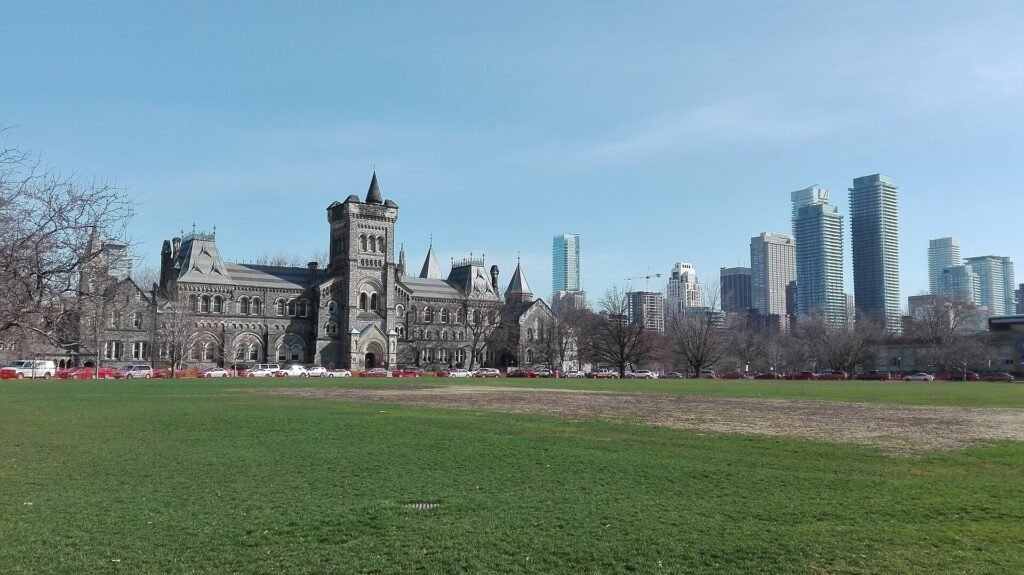
Featured image: University College, Toronto by GoginkLobabi, CC BY-SA 4.0, via Wikimedia Commons (resized).




Responses