Study in the Netherlands: A Guide for African Students

Students who study in the Netherlands can choose from a large number of English-taught degrees at research universities and universities of applied sciences. One feature makes the process simpler than in many countries: your university applies for your visa and residence permit for you.
This guide explains admission, the residence permit, the income requirement, work rules and funding.
Quick answer: Apply to the university, accept your offer, pay the required fees and send proof of funds. The university then applies to the immigration service for your entry visa and residence permit. You cannot submit that application yourself.
How the Dutch System Works
- Research universities focus on academic and research-led degrees
- Universities of applied sciences focus on professional practice
- Bachelor’s degrees take three or four years
- Master’s degrees take one or two years
Most applications start in Studielink, the national enrolment system, followed by the university’s own portal. Programmes with limited places, known as numerus fixus, have an earlier deadline, commonly in mid-January.
Admission Requirements
- A secondary or bachelor’s qualification the university considers equivalent
- English test results
- A motivation letter
- A CV and references for many master’s programmes
- Specific subject requirements, such as mathematics
Universities publish how they assess qualifications from each country. Check that page before paying an application fee.
Tuition and the Income Requirement
Students from outside the European Economic Area pay the institutional tuition fee, which is set by each university and is much higher than the statutory fee paid by EU students.
You must also prove that you can support yourself. For 2026, the immigration service sets the required amount for university and higher professional education students at €1,130.77 a month. Universities usually ask you to transfer a year of living costs to them, or to show the money in a bank account, before they submit your permit application.
Visa and Residence Permit Steps
- Accept your offer and meet any conditions.
- Pay the tuition fee and the permit application fee, which is €254 at the time of review.
- Send proof of funds and identity documents to the university.
- The university, as your recognised sponsor, applies to the immigration service.
- Collect your entry visa at the Dutch embassy or consulate.
- After arrival, collect your residence permit and register with the municipality.
To keep your permit, you must normally earn at least half of the credits for each study year.
Working During and After Study
Non-EU students can work as employees for up to 16 hours a week during the academic year, or full-time in June, July and August. Your employer must hold a work permit for you. Internships that form part of your programme do not need one.
After graduating, you can apply for an orientation year permit, which gives you up to a year to look for work in the Netherlands.
Scholarships
- The NL Scholarship for non-EU students at participating institutions
- University excellence scholarships and fee waivers
- Faculty and programme-specific awards
Most scholarships cover part of the tuition fee rather than all costs. Read each award’s terms and use our fully funded scholarships guide to assess the real funding gap.
Housing
Student housing is scarce in many Dutch cities. Some universities advise students not to travel without confirmed accommodation. Apply for housing as soon as the university opens its system and be alert to rental fraud.
Common Mistakes
- Missing the earlier deadline for limited-place programmes
- Underestimating the institutional tuition fee
- Sending proof of funds too late for the permit deadline
- Arriving without housing
- Working without the employer holding a work permit
Frequently Asked Questions
Do I need to speak Dutch?
Not for English-taught programmes. Dutch helps with part-time work and long-term career plans.
Can I apply for the visa myself?
No. Only the university can apply as your recognised sponsor.
Is health insurance required?
Yes. The type you need depends on whether you work. Ask your university which insurance applies to you.
Your Next Step
Check how your qualification is assessed, note programme deadlines and budget for tuition plus a year of living costs. Organize your file with the application documents checklist.
Sources
Reviewed: 2 October 2026. Fees and required amounts are revised regularly. Confirm current figures with the IND and your university.
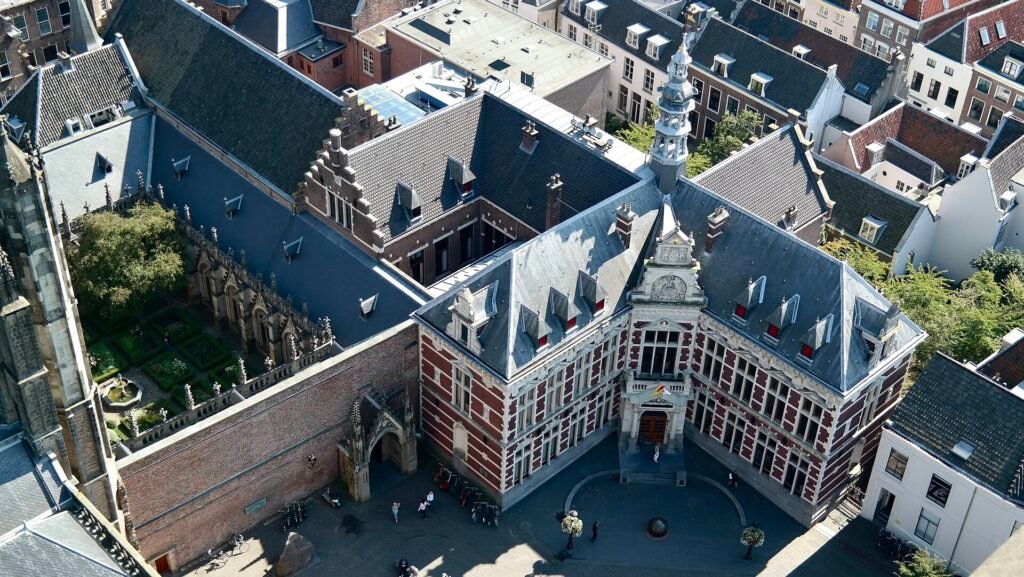
Featured image: Academiegebouw Utrecht by Choinowski, CC BY-SA 4.0, via Wikimedia Commons (resized).




Responses